
Disclosure: This post contains affiliate links. If you buy something through one of them, we may earn a small commission at no extra cost to you.
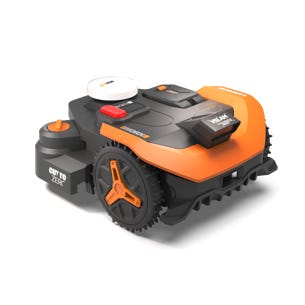
The Landroid Vision Cloud is WORX’s current flagship robotic mower, and it’s the model the whole 2026 lineup is built around. No boundary wire, no buried perimeter cable, no roof antenna. Just stereo cameras, cloud-based RTK positioning, and an app that maps your yard in a few minutes.
I went through the spec sheet across every model in the range, plus independent owner reviews, to see whether the wire-free pitch actually holds up on a real lawn.
The lineup and what each model costs
Seven models cover four yard sizes, split between standard and 4WD versions for sloped terrain:
| Model | Coverage | Price |
| WR310.1 | 1/4 acre | $1,199.99 |
| WR341 (4WD) | 1/4 acre | $1,999.99 |
| WR320.1 | 1/2 acre | $1,799.99 |
| WR342 (4WD) | 1/2 acre | $2,299.99 |
| WR340 | 1 acre | $2,299.99 |
| WR344 (4WD) | 1 acre | $2,999.99 |
| WR346 (4WD) | 1 1/2 acres | $3,699.99 |
The 4WD models add real capability, not just marketing. WORX rates the top-tier WR344 for slopes as steep as an 84% grade, which covers yards a standard 2WD mower would simply spin out on.
Setup and navigation
This is where the Vision Cloud earns its price. Owner reviews consistently describe full setup, including the auto-mapping scan that builds a 3D model of the yard, finishing in under 30 minutes. Older wire-based robotic mowers can take a full day to install.
Navigation runs on stereo-vision cameras paired with cloud-based RTK correction, which reviewers describe as centimeter-level accuracy without a buried wire or roof-mounted antenna. WORX includes lifetime free RTK Cloud service on every model, with no monthly subscription.
The one recurring caveat: camera-based navigation can struggle in very low light. Reviewers recommend the optional headlight accessory if you want the mower running at dusk or later.
Cutting, noise, and daily use
The mower runs on a brushless motor and auto-mulches fine clippings back into the lawn, so there’s no bagging or clipping cleanup. It runs at roughly 60 to 65 decibels, which reviewers compare to a normal conversation. That’s quiet enough to run before you leave for work without waking the neighbors.
Battery capacity scales with the model: 2.0Ah on the WR310, up to 5.0Ah on the WR344. Every model auto-returns to its dock when the charge runs low, and the app handles weather-responsive scheduling, so mowing pauses automatically if rain sensors trigger.
The app and smart features
The Landroid app runs on iOS and Android and covers real-time GPS tracking, multi-zone scheduling, and push notifications if the mower is tampered with or lifted mid-cycle. A quick-stop sensor halts the blade instantly if the mower is picked up.
Optional accessories extend the system further: an Anti-Collision System, a Find My Landroid GPS module for extra theft protection, and a Radio Link WiFi extender for yards where the signal doesn’t reach the far corners.
How it compares to Husqvarna
The closest real rival is Husqvarna’s Automower line, which uses GPS and cellular-based EPOS navigation instead of cameras and RTK Cloud. Comparable Automower models run roughly $700 more than the equivalent Landroid, and Husqvarna’s cutting system uses three small pivoting blades versus the Landroid’s single blade.
Should you buy it
Measure your yard honestly before picking a model. The 1/4-acre WR310.1 is the easiest entry point at $1,199.99, but buying too small a mower for a growing yard means it’ll struggle to finish a full cycle. If your yard has real slopes, spend the extra few hundred dollars on a 4WD model rather than fighting traction on the 2WD version.
For seasonal upkeep once you own one, see my Landroid maintenance and winter storage guide.
Keep reading: my full WORX brand review, how to choose the right WORX tool for your yard, and where to buy WORX authentically.