
Disclosure: This post contains affiliate links. If you buy something through one of them, we may earn a small commission at no extra cost to you.
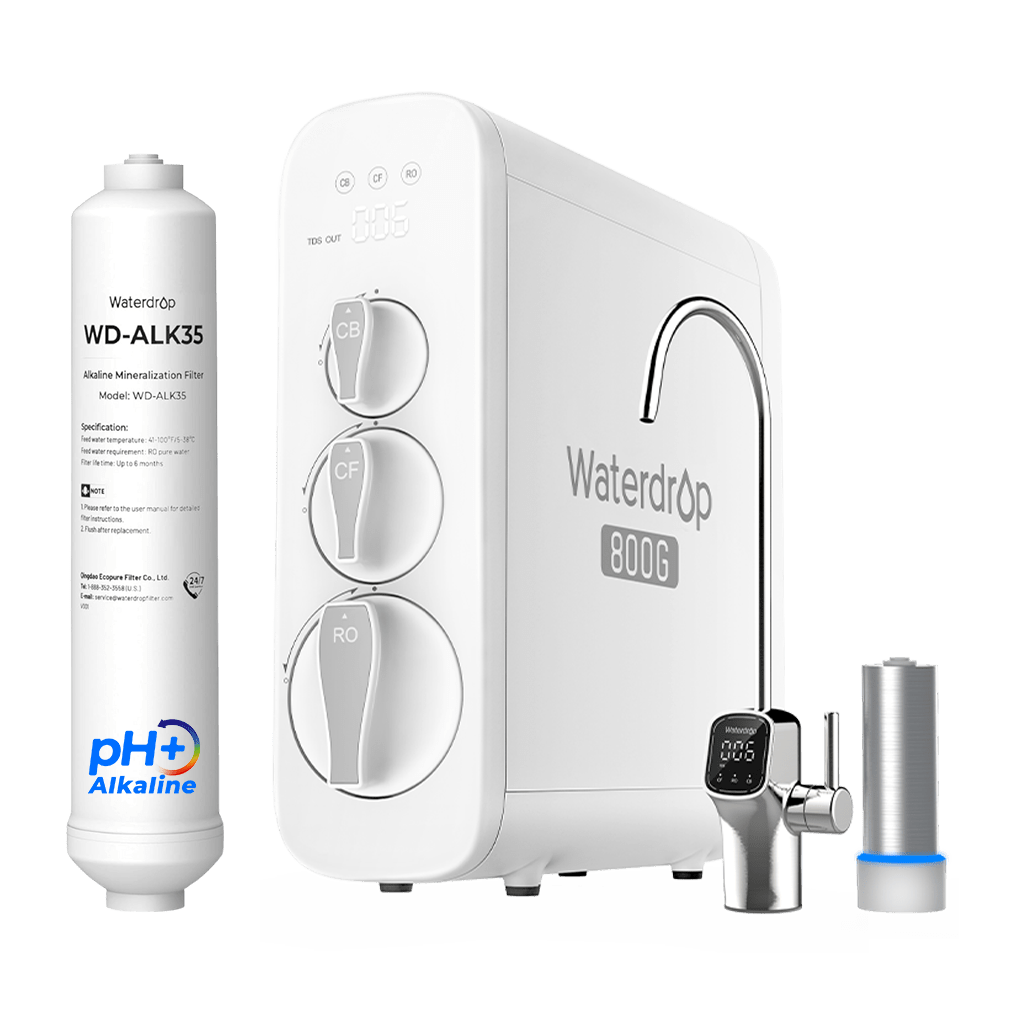
The G3P800 is Waterdrop’s most-reviewed tankless RO system, sitting at $878.99 (down from $1,028.99 with code WDG3P800) and rated for 800 gallons a day. I went through the spec sheet, an independent lab test, and a first-hand review from a national outlet to see if it earns that price tag.
What’s actually in the box
The G3P800 is a tankless, 10-stage system built around a 0.0001-micron RO membrane. It ships with the smart LED faucet, a power adapter, a built-in UV sterilizer, feed water adapter, drain saddle, tubing, and mounting hardware. Waterdrop lists it as a 30-minute DIY install.
It’s NSF/ANSI 42, 53, 58, and 372 certified, meaning it’s verified to reduce chlorine, taste and odor, TDS, and lead, on top of general contaminant claims like PFOA and PFOS reduction up to 99 percent. The 3:1 pure-to-drain ratio means it wastes roughly a third as much water as older tank-based RO designs.
What the lab testing found
Independent testing site WaterFilterGuru gave the G3P800 a 9.21 out of 10, calling it the highest-scoring tankless under-sink RO system they’ve tested. Their measured output came in at 886.54 GPD, above Waterdrop’s own 800 GPD claim.
Contaminant reduction in that test included 100 percent of selenium, 78 to 100 percent of fluoride, up to 100 percent of hexavalent chromium, and a 93 to 95 percent drop in total dissolved solids. Those are lab-verified numbers, not marketing claims.
What buyers and reviewers actually say
On Waterdrop’s own site the G3P800 holds a 4.9 out of 5 across 101 reviews. On Amazon, with a much bigger sample, it sits at 4.6 out of 5 across 3,677 reviews. That kind of consistency at scale is a good sign.
Reviewed.com’s managing editor tested it hands-on and described the filtered water as having “a purer texture” than tap water, and said it noticeably cut mineral buildup in her coffee maker. She called it a genuine upgrade over a fridge dispenser for taste.
Her complaints were practical rather than about water quality: flow is slower than a standard kitchen faucet, the water doesn’t get as cold as fridge-dispensed water, and despite the “30-minute DIY” claim, she ended up hiring a plumber, noting “unless you have extensive experience in plumbing and construction, it’s best to hire a pro.”
The trade-offs to know before buying
- Warranty is 1 year. Waterdrop’s longer 2-year coverage is reserved for eligible X Series systems, not the G3P800.
- Installation cost isn’t in the sticker price. Budget for a plumber if you’re not confident with under-sink plumbing.
- Filters need tracking. Like every RO system, ongoing filter costs add up; I cover realistic upkeep in my maintenance guide.
Should you buy it
If you want lab-verified RO filtration without sacrificing under-sink cabinet space to a tank, the G3P800 backs up its price with real third-party test data and a large, consistent review base. Set aside installation cost as a separate line item, and check the current return window before buying, since promo pricing sometimes ties to final-sale terms.
For the full brand picture, see my complete Waterdrop review. If you’re weighing it against other systems in the lineup, my how-to-choose guide breaks it down by budget and space. Buying outside the official channels? Check where to buy Waterdrop authentically first.
Keep reading: my full Waterdrop brand review, how to choose the right Waterdrop system, and how to keep it running long-term.