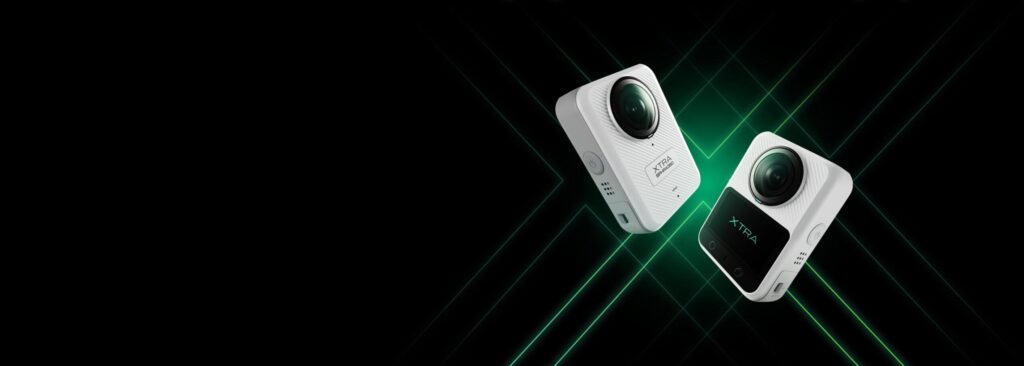
The Xtra Muse is a pocket-sized gimbal camera built around a 1-inch sensor. It is the flagship of Xtra’s five-camera lineup, and the one this page covers in depth.
It is aimed at vloggers, casual creators and anyone who wants smooth handheld video without carrying a stabilizer rig. Think walking-and-talking clips, product demos and interviews.
This page draws on the brand’s spec sheets, its published policies and the notes of an independent reviewer who bought a unit with their own money. No hands-on testing is claimed here. The short version: a big sensor and a mechanical gimbal on paper, a few weak spots the reviewer flagged, and one open question about who builds it.
What the Xtra Muse Is
The Muse pairs a 1-inch CMOS sensor with a mechanical three-axis gimbal inside a compact body that you hold like a small handle. Instead of relying on software to hide your footsteps, motors in the gimbal do the steadying physically.
A 2-inch touchscreen handles framing and menus. Master Follow is the brand’s tracking feature, and Xtra says it keeps a moving subject framed automatically. It is aimed at people who are both the presenter and the camera operator.
Vertical video has its own software mode. You do not have to turn the gimbal head by hand to frame a clip for TikTok or Reels. The camera also works as a USB webcam, and the independent reviewer singled that out as a pleasant surprise if you work from home.
The package includes the camera, a wrist strap, a carrying bag, a USB-C charging cable and a handle with a 1/4-inch thread for tripod mounting. You can browse the whole Xtra range on Xtra’s own store before you decide.
Key Specs at a Glance
- Sensor: 1-inch CMOS
- Video: 4K at up to 120fps
- Stabilization: mechanical 3-axis gimbal
- Color profile: 10-bit X-Log
- Screen: 2-inch touchscreen
- Tracking: Master Follow
- Vertical shooting: native software mode
- Storage: none built in, so bring a microSD card
- Extras: USB webcam mode
The independent reviewer also reported a body weight of about 180 grams, battery life of roughly two hours, a recharge of about 35 minutes and a startup time near five seconds. Those are one person’s measurements, not brand claims.
On storage, a card is not optional. Footage at the top frame rate fills a card quickly, so a roomy one is a sensible companion purchase.
What an Independent Reviewer Found
The only hands-on feedback behind this page comes from a photography-focused site that is not affiliated with Xtra. It judged the Muse a very solid camera, even for someone who is not a dedicated vlogger.
What it liked
- A pocketable body, roughly the size and shape of a hot dog.
- Battery life of around two hours, with a short recharge.
- A fast startup, so you can start filming almost immediately.
- Crisp, vivid footage when the light is good.
Where it fell short
- The built-in microphone is underwhelming.
- Close-up macro shots struggle.
- The touchscreen feels cramped for fine adjustments, although the companion phone app helps.
- The app has some untranslated menus and the odd unexpected pop-up.
Audio deserves a second look if you plan to talk to camera. The Muse does not connect to DJI’s Bluetooth wireless microphones, so confirm that any microphone you pick will pair with it before you buy.
How It Compares With the Osmo Pocket 3
DJI’s Osmo Pocket 3 is the camera Xtra itself sets the Muse against, on a comparison page of its own. On paper, the headline imaging hardware is nearly the same.
| Xtra Muse | DJI Osmo Pocket 3 | |
|---|---|---|
| Imaging sensor | 1-inch CMOS | 1-inch CMOS |
| Stabilization | Mechanical, three axes | Mechanical, three axes |
| Top video mode | 4K at up to 120fps | 4K at up to 120fps |
| Log profile | X-Log (10-bit) | D-Log M (10-bit) |
| Subject tracking | Master Follow | ActiveTrack 6.0 |
| Portrait framing | Built-in software mode | Gimbal head must be turned by hand |
| Wireless mics | DJI’s Bluetooth mics will not connect | Full DJI microphone range |
So the real differences sit in software and ecosystem. The Muse’s built-in portrait mode saves you from turning the gimbal head by hand. DJI’s Pocket 3 reached the market in 2023 and has a wider accessory range, including wireless microphones the Muse cannot use.
Price is a separate question. The Pocket 3 launched in 2023 at $519, and reports say tariffs have since pushed its street price far above that. Xtra’s own price for the Muse can change, so check the current price at Xtra and set it against DJI’s current price before you decide.
The open question about who builds it
Tech outlets have reported that FCC filings show circuit board designs matching the Pocket 3’s. Separately, a security consultant who examined the Xtra app’s code is said to have found thousands of leftover references to DJI software.
Asked about it, both companies declined to comment, so no link has been confirmed or denied. Xtra describes itself as an independent start-up registered in Delaware. For a buyer, the practical concern is how long firmware updates will keep coming and how a warranty claim would unfold a couple of years on, not what ships in the box.
Who It Suits and Who Should Skip It
The Muse fits vloggers and casual creators who want gimbal-smooth, face-to-camera footage from a small body. If you value a big sensor and a built-in stabilizer over a long accessory list, it is easy to like.
Skip it if close-up macro work is central to what you shoot, if you need a polished companion app, or if you already own DJI’s wireless mics. And if knowing exactly who stands behind a brand outranks saving money, that is a fair reason to look elsewhere.
Other jobs call for other cameras. Xtra also sells the Atto wearable camera, the 360 and two action cameras, the Edge and Edge Pro, each built for a different style of shooting.
Care, Returns and Warranty
Looking after the gimbal
The gimbal is the moving part that defines this camera, so the care advice centers on it. After you switch the camera on, give the startup calibration time to finish before you move it. Never push the gimbal arm into place yourself, and avoid dropping or setting the camera down on the gimbal side.
Returns and warranty
Xtra’s return window is 30 days, counted from the day the parcel arrives. To qualify, send back the original packaging, every accessory, any gifts that came with the order and the manuals. Xtra says it supplies the return label.
A return is refused in four cases:
- the 30 days have passed;
- there is no proof of purchase;
- an accessory or other piece is missing;
- the damage came from unauthorized use or modification.
Warranty coverage is for defects in materials or workmanship, and the remedy is a repair or a replacement. No single length is stated for the whole range because it varies by product series, so read the listing for your model. Two limits apply: service is available only in the country of purchase, and opening the shell or modifying the camera voids the coverage.
Shipping
- Fee: a $9.90 flat rate, waived on orders above $99
- Handling time: within a day on business days
- Transit: three to five business days
- Where: the United States only, covering P.O. boxes and military addresses
- If something goes wrong: report a damaged or missing parcel within 7 days, to after-sales@xtra-us.com
To keep returns and warranty simple, order straight from Xtra. You can place an order on Xtra’s store, where the policies above apply as written.
FAQ
Does the Xtra Muse have built-in storage?
No. Slot in your own microSD card before you shoot. The Atto and 360 are different, since both include built-in storage.
Can it shoot vertical video?
Yes. A native software mode handles portrait framing, so the gimbal head stays put.
Will DJI accessories work with it?
Only in part. The Muse cannot pair with DJI’s Bluetooth wireless microphones, even though reports describe its hardware as closely related to DJI’s.
How is the battery?
The independent reviewer reported roughly two hours of use and about 35 minutes to recharge. The camera charges over USB-C.
Where does Xtra ship, and who handles support?
Orders go to addresses in the United States only. Write to after-sales@xtra-us.com about a repair, a replacement or a return, and use info@xtra-us.com for anything general.
The Verdict
The Muse suits creators who want 1-inch-sensor gimbal footage from a body that slips into a pocket. The independent reviewer’s notes line up with the core of the spec sheet, and the weak spots it names are narrow: audio, macro and app polish.
The open question about who builds it does not change what is in the box, but it is a fair factor when you think about long-term support. If you can live with that, see Xtra’s range at Xtra’s store and check the current price of the Muse there.